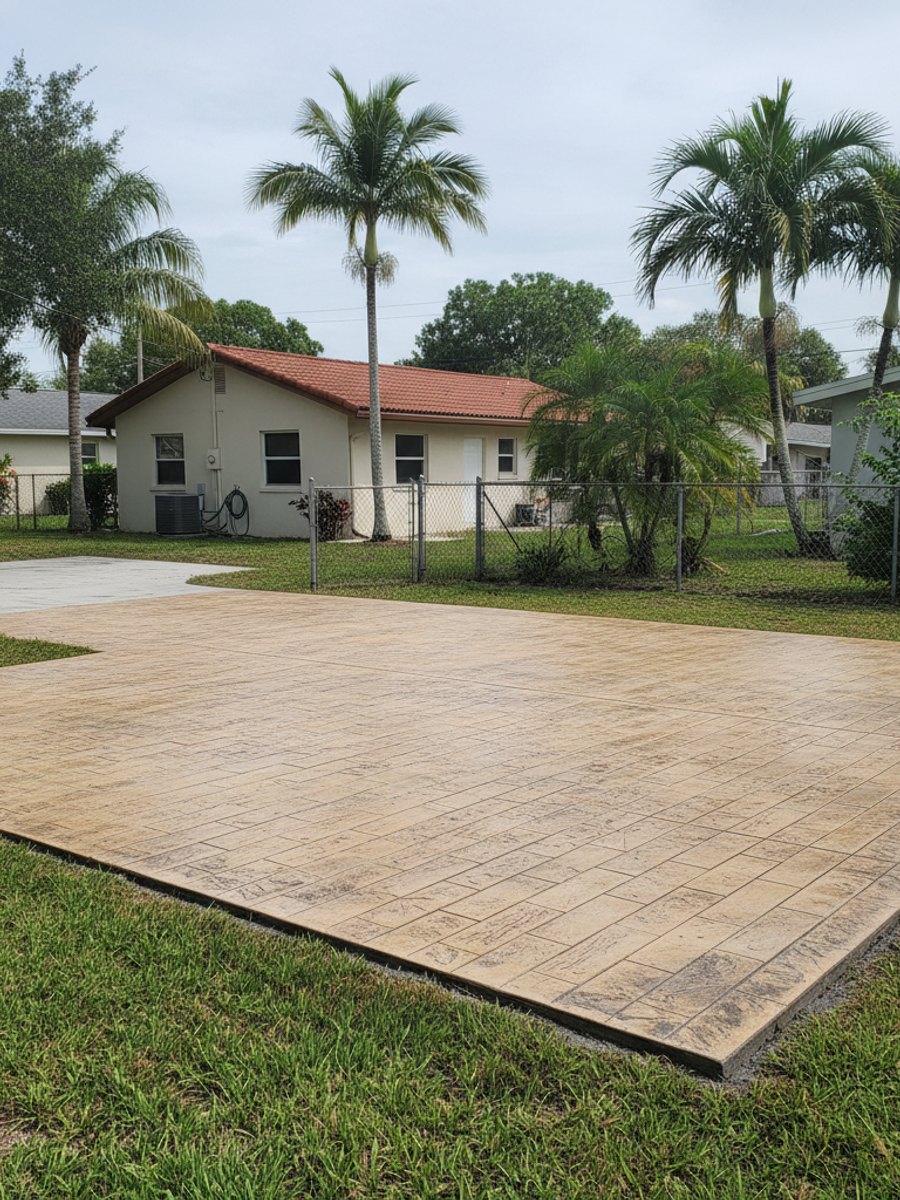
Most people shopping for a concrete contractor have never had to think about concrete before. Then a driveway cracks or a pool deck starts pitting and suddenly you're getting three quotes that all look different, for reasons nobody explains. Here's what actually separates a contractor worth hiring from one you'll be calling back in two years.
Licensing means something specific in Florida
Florida splits this into state-certified contractors, who can work anywhere in the state, and county-registered contractors, who are licensed to work only within Volusia County. Either one is legitimate for residential concrete work. What matters is that the license is current and that it actually covers concrete or general contracting, not just a handyman registration. Ask for the license number and look it up yourself through the Florida DBPR site. It takes two minutes and it's the single fastest way to eliminate someone who shouldn't be pouring your driveway.
Insurance matters just as much. You want general liability and, if they have employees, workers' comp. If a laborer gets hurt cutting rebar on your property and there's no coverage, that liability can land on you as the homeowner.
What a real quote actually spells out
A driveway or patio quote that just says "4 inch slab, $X per square foot" is missing half the information you need. Ask what PSI mix they're using. Most residential slabs in this area should run 3,000 to 4,000 PSI, and driveways that'll see a boat trailer or an RV need to be on the higher end. Ask whether they're using rebar or wire mesh. Mesh is cheaper and fine for a lot of patios, but rebar holds a slab together better once it cracks, and in sandy soil with any settlement, it will crack eventually. The question isn't whether, it's how it holds together when it does.
Ask about base prep too. A slab poured straight onto native Daytona Beach sand without a compacted base is asking for trouble. You want a compacted stone or sand base, typically 4 to 6 inches, before anything gets poured. Skipping that step saves a contractor half a day and costs you a driveway that dips at the edges within a couple of years.
Control joints should be part of the conversation, not an afterthought. These are cut roughly every 8 to 10 feet, and the timing matters: within 24 hours of the pour, before the slab decides on its own where it wants to crack. A contractor who saw-cuts joints the same day understands this. One who comes back "whenever" is gambling with your slab.
Permits, inspections, and what Volusia County actually checks
Most driveway, slab, and pool deck work in Daytona Beach and the surrounding towns needs a permit, either through the City of Daytona Beach or Volusia County, depending on where the property sits. A legitimate contractor pulls that permit themselves and schedules the inspections, usually a base or form inspection before the pour and sometimes a final inspection after. If a contractor tells you permits are "optional" or that they'll "just take care of it" without ever mentioning an inspection, that's a problem. Unpermitted concrete work can come back to bite you at resale, when a buyer's inspector or the title company asks for permit history you don't have.
If you're in one of the newer subdivisions off LPGA Boulevard or out toward the Pelican Bay area, check your HOA rules too. Some restrict driveway finishes, colors, or even whether stamped concrete patterns are allowed. Older neighborhoods like Holly Hill, South Daytona, and much of the beachside typically don't have an HOA to deal with, but they come with their own wrinkle: older lots.
Why the ground here changes the job
Daytona Beach sits mostly on sandy soil, which drains fast and doesn't hold water the way clay does further inland. That's good news in one sense, less risk of the soil expanding and heaving a slab the way you'd see in other parts of the country. But sandy soil compacts unevenly if it isn't done right, and in low-lying areas near the Halifax River or the Intracoastal, the water table can sit close enough to the surface that it affects how a slab drains and cures.
Older streets, especially in neighborhoods built in the 1940s through 60s, often have shallow tree roots from mature live oaks running under the yard, old fill that was never properly compacted, and drainage that was designed for a different era of rainfall expectations. A contractor who's worked here knows to check for that before quoting a price, not after the saw hits a root.
Then there's the weather. Rainy season runs roughly June through September, with afternoon thunderstorms that can roll in with almost no warning. A pour scheduled for 2pm in July is a bad idea and any contractor who's been doing this locally knows to pour early morning instead. Hurricane season, June through November, means schedules sometimes shift, and a contractor who won't budge a pour date when a storm is tracking toward the coast isn't being tough, they're being careless with your concrete.
Salt air is another local factor, especially for pool decks and slabs closer to the beachside. It accelerates corrosion on any exposed rebar or mesh, so proper concrete cover, generally at least 1.5 to 2 inches over steel, matters more here than it would forty miles inland.
What to walk away from
A bid that's dramatically lower than the others usually means something is being skipped, whether that's base prep, mix strength, rebar, or the permit fee itself. Cash-only payment with no written contract is a red flag on any job over a few hundred dollars. So is a contractor who can't tell you how long before you can drive on a new driveway. The honest answer is usually 5 to 7 days for light foot traffic and closer to a full 28 days before the concrete reaches its design strength and can handle heavy vehicle loads reliably.
Walk away from anyone who won't put the scope in writing, including thickness, mix design, and reinforcement. Walk away from anyone who tells you inspections aren't necessary. And be cautious of a contractor who wants full payment before the pour even happens, rather than a deposit with the balance due on completion.
If you're comparing quotes for a driveway, patio, pool deck, or a repair on an existing slab, ask these questions of everyone you call, not just the company you're leaning toward. It's the fastest way to see who actually knows this trade in this part of Florida. We've laid out the kind of work we do, from new slabs to resurfacing and repair, at Charis Concrete Solutions, and we're happy to walk through the specifics of your property before you commit to anyone.